Showing posts sorted by relevance for query cyclocross. Sort by date Show all posts

Tuesday, August 13, 2013

An Introduction to Cyclocross, Plus Three Workouts


By Hunter Allen, PCG Founder/CEO and Master Coach
originally published in Cycling Weekly

Peaks Coaching Group Cyclocross

Cyclocross is indeed a unique subset of cycling. With that uniqueness comes a very different set of training and racing demands. Of course there are similarities to mountain biking and road racing

Tuesday, August 5, 2014

Using a Power Meter in Cyclocross Training and Racing

By Hunter Allen and Dr. Andrew Coggan
an excerpt from Training and Racing with a Power Meter, Second Edition

PCG elite coach Christian Sheridan crushes cyclocross.
Using your power meter in cyclocross is not only effective but arguably one of your best weapons in pushing yourself to the next level. Cyclocross has its own unique set of demands: you must be able to create quick bursts of effort over small obstacles, leap off the bicycle, and run while carrying it for up to thirty seconds, all while maintaining a pace at your functional threshold power (FTP) and above for 40-75 minutes. It’s nearly impossible to hold a steady power or even look at your power meter during a race or hard training session. However, you can use your power meter to learn quite a few things about the demands of CX and tailor your training so that you’ll be ready for the next race.

Power meter files from CX races typically average about 20-40 watts below an athlete’s actual FTP, because there is so much down time when the athlete is either coasting down a technical hill or off the bike and running, and because of the lack of traction on many of the courses. Putting the power to the ground skews the power down, and one has to take this into consideration when reviewing CX power files.

Because of these running and technical coasting sections, it’s hard to determine the exact muscular demands of CX. When viewed in a quadrant analysis plot, a CX race contains the largest amount of the effort in QII, which represents slow pedaling and higher force, but QIII (slow pedaling, low force) and QIV (fast pedaling and low force)  are also heavily involved in CX.

Peaks Coaching Group power meter cyclocross race racing training

When you examine your power file from a CX race, one of the first things you might notice is that it looks a lot like some of those criteriums you did earlier in the year. Loads of stochastic power spikes, easily discernible laps, and big race-winning type efforts are all commonalities to road criterium races. Many aspects of a CX power file are very interesting, such as the power bursts needed in the race, the amount of rest in each lap, and the overall training stress accumulated in the race.

One thing that is important to identify in a CX power file is the number of watts above your FTP and how long each of these efforts were; in other words, how many matches you have to burn. A CX “match” is a little different than a match in a road race or a criterium, because most likely you’ll already be at your FTP and then have to do hard efforts above it, depending on the terrain and your competition. The matches are really just bursts of flames coming up from the already raging fire! However, identifying these flames and their intensity will allow you to train more specifically for the effort. Use the “fast find” feature in WKO+ to help identify them.

Peaks Coaching Group power meter cyclocross racing training

After reviewing hundreds of CX race and training power files, I have determined that another specific training workout good for CX is a variation on the Level 7 micro-burst workout. I call this workout the 30-30-30 workout because it’s comprised of 30 seconds at 150% of FTP, 30 seconds coasting (0% of FTP), and 30 seconds of running. By extending the intervals to 30 seconds, it changes the type of workout from a level 7 to a level 6 workout, since at 30 seconds the anaerobic capacity system is highly utilized. The 30-30-30 workout is done continuously for 10 minutes, and then a rest is taken for 5 minutes before doing two to four more sets total.

The 30-30-30 Cyclocross Workout

1. 15-minute warm-up at level 2
2. 5-minute hard effort at 110% of FTP
3. 5 minutes easy at level 2
4. 2 x 10 minutes of 30-30-30, which is 30 seconds riding hard as you can, 30 seconds coasting and not pedaling, 30 seconds dismount and running fast. Ride 10 minutes at level 2 after each 30-30-30 effort.
5. 4 x 2 minutes anaerobic capacity work at 150% of FTP. Rest 2 minutes after each.
6. 10 minutes at level 2
7. Finish with 10 x 1 minute fast pedaling at 110+ rpm; 1 minute on, 1 minute off at 80 rpm.
8. Cool down for 15 minutes.

One of the most important reasons to use a power meter is for the ability to train to the demands of a specific event, and this is highly applicable for cyclocross. Addressing the specific need of a strong anaerobic capacity, along with highly tuned technical skills (dismounting the bike, running with the bike, and remounting) creates the perfect blend of a workout in the 30-30-30. Along with this anaerobic capacity workout, CX demands a strong FTP, so the traditional level 4 FTP workouts done at 4 x 10, 3 x 15, and 2 x 20 minutes at FTP are important for the successful CX racer.

Sam Krieg, PCG coach and elite cross racer, said, “The ability to train with power on your ‘cross bike and develop specific ‘cross workouts has allowed me to not only coach ‘cross riders more specifically but also improve my own fitness. My favorite workout is the 30-30-30 that Hunter developed, because of the structure it provides, the nearly identical similarities to my ‘cross races, and it forces me to go hard for the entire ten-minute set.”

Kris Walker, the national champion in the 2009 masters (45-49) time trial and the 2008 masters cyclocross events, adds, “As a classic steady-state rider, my forte is my ability to hold a constant power for the entire event, and cyclocross is very challenging to me because I have to train my weakness, anaerobic capacity. After reviewing my power files with Hunter, we were able to determine just exactly how much anaerobic work I was going to need in order to be on the top step of the cyclocross national championship podium.”

Cyclocross is another discipline within cycling in which using a power meter to train more quantitatively and also more specifically to the demands of CX allows users to improve their performance. A key component of this improvement hinges on the ability of the athlete to mimic the demands of upcoming CX races and develop training routines for them.

Good luck out there!


Hunter Allen is a USA Cycling Level 1 coach and former professional cyclist. He is the coauthor of Training and Racing with a Power Meter and Cutting-Edge Cycling, co-developer of TrainingPeaks’ WKO software, and CEO and founder of Peaks Coaching Group. He and his coaches create custom training plans for all levels of athletes. Hunter can be contacted directly through PeaksCoachingGroup.com

Friday, December 2, 2011

Cyclocross Power: A Detailed Look into Ryan Trebon’s Watts by Russ Stevenson

Cyclocross Magazine got a rare look at a top-’crosser’s power file: Ryan Trebon’s (LTS-Felt) race winning effort at the 2011 Planet Bike USGP. Power specialist and coach Russell Stevenson analyzes the data and looks at exactly why – and where – Trebon is so good. See for yourself what constitutes a world-class cyclocross talent!
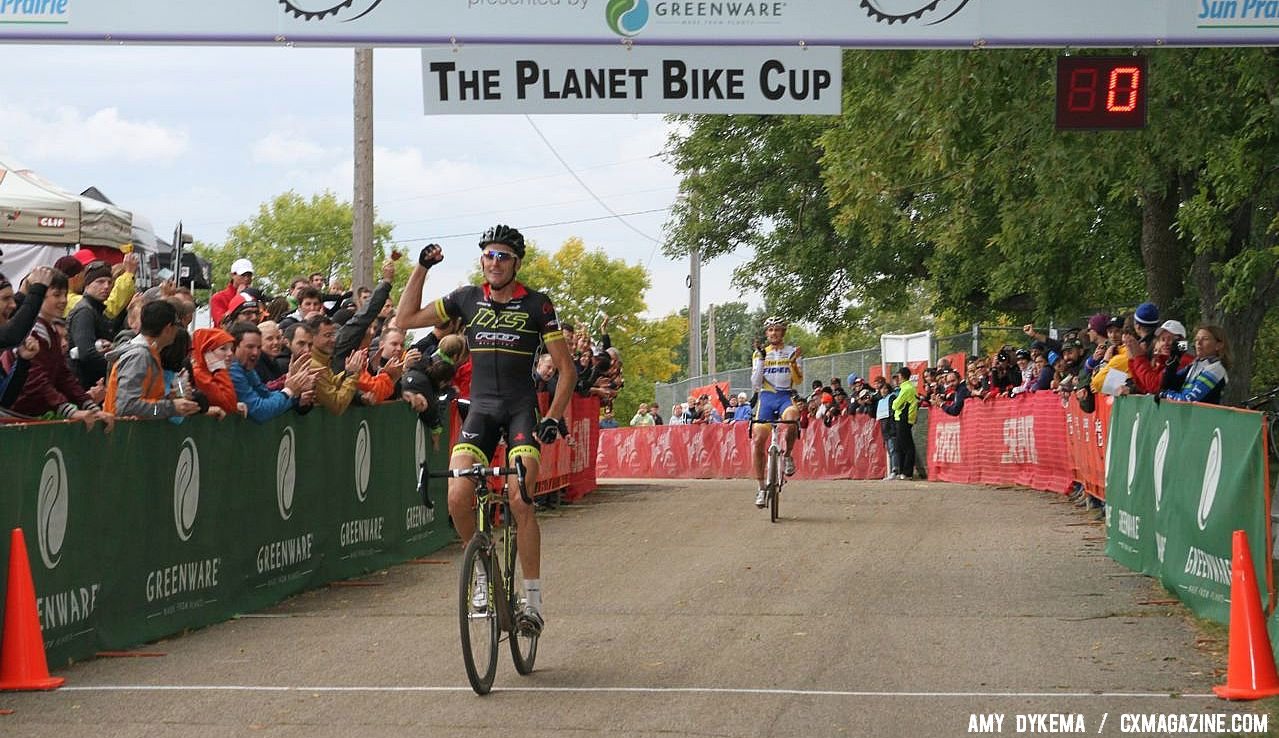
Ryan Trebon took his first UCI win of the season at Planet Bike Day 1. Now we get to look at the race winning effort! © Amy Dykema
by Russell Stevenson
Power meters have been commonplace in cycling for a decade. However, their use in cyclocross is a relatively new, but growing trend. Look around: Some of the best ’cross racers in the US and Europe are powering up for both their racing and training, and power meters are coming in various forms these days, a far cry from what was available just six or seven years ago. Whether you’re dropping big money on the latest trick carbon widgets or just out there for there cold post (or in-) race beers, if you’re into going faster, you should consider investing in a power meter and learn how to use it.
I’m going to throw out a lot of techy stuff here, so try to keep up. If you want to dig deeper into understanding my power terminology, go to www.peakscoachinggroup.com.
My background in cyclocross racing dates back to my humble beginnings around 1998 in my home of Seattle, Washington. With years of road and MTB racing under my belt, I took to the sport quickly. These days, I’m still out there racing a handful of the UCI Elite races each year, although usually from the back row and with an entirely different motivation. I’m really just out there to have a good time, represent my generous sponsor (Raleigh Bicycles) and enjoy the whole experience. The riders six to seven rows in front of me are paid pros who don’t cut corners. As a coach, it’s been an awesome learning experience to learn about what it takes to be a world class ’cross racer. So let’s define fast …
I’ve had the privilege of getting my paws on one of Ryan’s Trebon’s power files from the Planet Bike USGP in Sun Prairie, where he bested two-time world champ Bart Wellens of Belgium. This file will definitely set our high mark! We now know what the workload looks like to be at the front (and win) a UCI race. In a later story, I’m going to dive into this same subject for women.
Ryan’s power is noteworthy. Prior to this race-winning effort, Ryan had posted a different file on Facebook that immediately caught my eye as off-the-charts. It showed average wattage numbers comparable to Alpine stage winners of the Tour de France, but for a full hour! I pestered him for long enough, and he eventually shared this race file with me. To my amazement, I see now he truly is that good.
Ryan’s Facebook post of that earlier race was a Garmin Connect URL with pretty limited information. His race file showed an average wattage of 472. “No way,” I thought, “that can’t be right.” After a closer look and factoring in the “zeroes” (or time spent not pedaling) the average power for the race was 409 watts, or 5.1w/kg (Trebon weighs approximately 80kg, or 176 pounds – impressive for a guy who’s 6′5″!). Still, that’s a big, big number if you know anything about average wattage. But let’s look at his USGP win in more detail, and I think you’ll quickly see it’s not always about average watts – especially in cyclocross.
Note: I am not Ryan’s coach. Ryan is coached by Jim Lehman of Carmichael Training Systems. I am taking my best calculated guess at Ryan’s personal stats. I don’t have full access to his training library, only this one race.
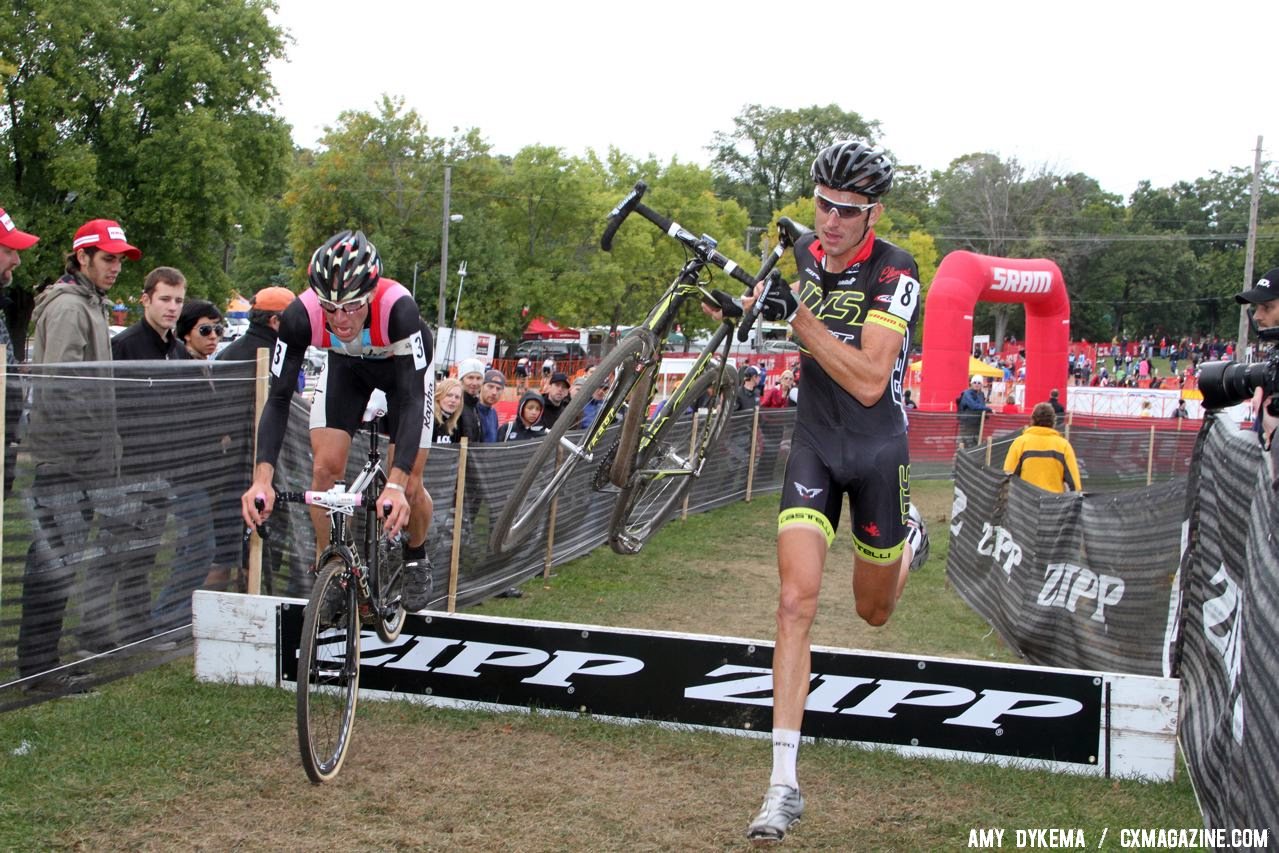
Powers opted to always stay on his bike, while Trebon ran the barriers and stairs. © Amy Dykema
Ryan’s USGP Planet Bike file stats:
Average race wattage was 399 or 424 normalized. His max power was 1431 watts. He expended 1424KJ, had a TSS score of 104 and an average cadence of 80 rpm. Ryan uses a Quarq Cinqo power meter combined with the Garmin Edge 500 CPU.
Based on this one file, I estimate Ryan’s FTP (functional threshold power) to be at or near 415 watts, or 5.2w/kg – good numbers, for sure. Typically when riders hold 150% of FTP for longer than a few minutes, they’re seeing stars. Ryan can continually go to 200% of his FTP. Ouch! That he can go that high, repeatedly for an hour, is a testament to his fitness and grit along with his unique physiology. One of the toughest things about cyclocross is that it rewards riders who have a large anaerobic capacity. Ryan’s power file back that assertion up, and his numbers show that his anaerobic capacity, coupled with a high threshold point, set him apart.
Further analysis shows that Ryan spent the majority of this race between 400w and 800w, or between about 95 and 190% of his FTP. He accelerated more than 120 times at or near 850w for 20 to 30 seconds (10.6w/kg). 120 times! Seeing this sparks my interest in his day-to-day training files. I can’t be sure if he’s training like he races, but whatever he’s doing is working well for him.
Looking at the above-average wattage durations, it’s clear that in ’cross racing, it’s all about high sustained power output combined with massive accelerations. The longest sustained effort in this race was less than 60 seconds before the power shuts off completely. When you consider how Ryan comes to these high levels and the time he’s spending there (very short), the importance of maximal power and the “repeatability” of these efforts becomes crucial. More on this in a second.
Some insight into how Ryan creates power is something maybe only his competitors ever get to see. Ryan is a bit of a pedal masher, pedaling at an average cadence of 80. That’s not a bad thing because wattage is a combination of force and speed. He pedals with high force and with relatively low pedal velocity or cadence. “Tree Farm,” as he’s nicknamed, uses a 177.5 crank and should be glad he does. Knowing his pedaling style, if he opted for something more standard, like a 175 or 172.5 crank length, he wouldn’t be utilizing his strength, muscle composition and leverage to it’s fullest. Years ago at a stage race in Oregon, I remember calling him out for using a 175 crank. I assumed a guy like him should be using a 177.5 or longer length to maximize his height and leverage. I asked him about it and he replied, “I don’t know, should I? It’s all I have.” At that time, I was as naive as he was and merely assumed that longer would be better. These days we have the technology to know that for Ryan, a longer crank is better.
Riders produce power in different ways. For example, I pedal at or above 100 rpm most of the time because it’s harder for me to create wattage from force. My muscle composition is a good mix of fast and slow twitch muscles, with the majority probably leaning more to the slower type 1 type. I wind it up slowly but can continue to build and build to maximal power, compared to Ryan’s full-on punchy style that he uses to put the hurt on his competitors out of each turn. The cadence to wattage comparison is important because you can now find your own sweet spot of economy and power output.
Another stand-out aspect of Ryan’s race is his maximal power. Out of the blocks he does a 1430w sprint, accelerating to over 27 mph. He goes on to produce 11 more maximal sprints at 1200+w throughout the race, ending with a final maximal kick within the final 500m of 1190w. That he can repeat those efforts shows incredible neuromuscular power and economy. His decline rate, or “fatigue resistance,” is also world class, as he only loses six percent of his maximal power over a one-hour race. That’s also a very important stat.
How does he do that? I can’t say for certain, but I have to assume he practices these repeated accelerations regularly while at or near his FTP. I’ll also assume that Ryan has the biological gift of a massive cardiovascular system, a naturally very high VO2 max and a perfect muscle fiber balance suited for cycling.
Besides obviously being a world caliber professional racer, Ryan states: “The race was pretty tactical with Jeremy Powers, Bart Wellens and me at the front. None of us really [were] attacking – just riding a fast tempo and waiting for others to make a mistake. I felt very good technically that day and never felt under pressure, so I had lots in reserve for that last lap.”
My interpretation of “Felt good technically” and “No one attacking” means 1) Ryan probably wasn’t burning too many matches to be at the front, and 2) He was able to conserve energy in the technical parts of the course. As a racer, I know that these two sensations build your psychological confidence in a big way and, physiologically, you actually have more in the tank when it matters most. Lethal!
The majority of his race was on, off, on, off – repeatedly. Cyclocross power files look like a young and very jagged mountain range with nothing but peaks and valleys. One standout stat is that he didn’t pedal for a full 16% of the race. There are always going to be portions of a ’cross race off the bike or coasting, but 16% seems high. Usually, the guy who pedals less has more energy at the end. Hunter Allen, co-Author of the book Training and Racing with a Power Meter, even states that the best road racers don’t pedal 15% of the time or more. That 16% is comparable to a long road race, which is a surprising.
When I asked Ryan about his winning strategy, he commented, “I attacked with a half lap to go through a technical section, and I just kept applying the pressure the remainder of the lap. I knew I had to have at least three to five seconds going into the run-up on the last lap to win.”
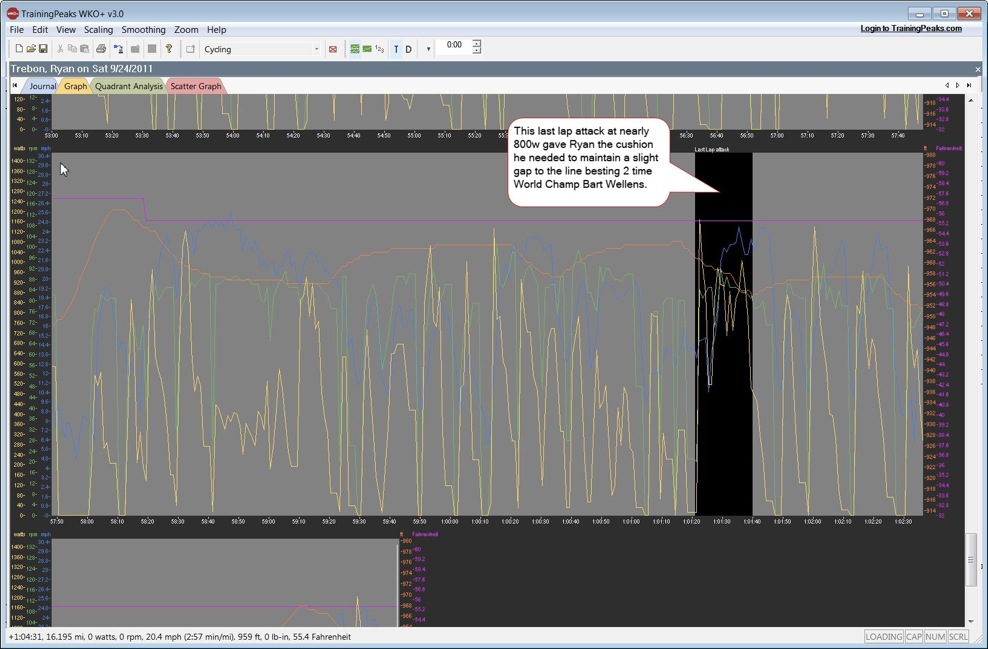
This last lap attack at nearly 800 watts gave Ryan the cushion he needed to beat two-time world champ Bart Wellens. Photo and power file courtesy Ryan Trebon.
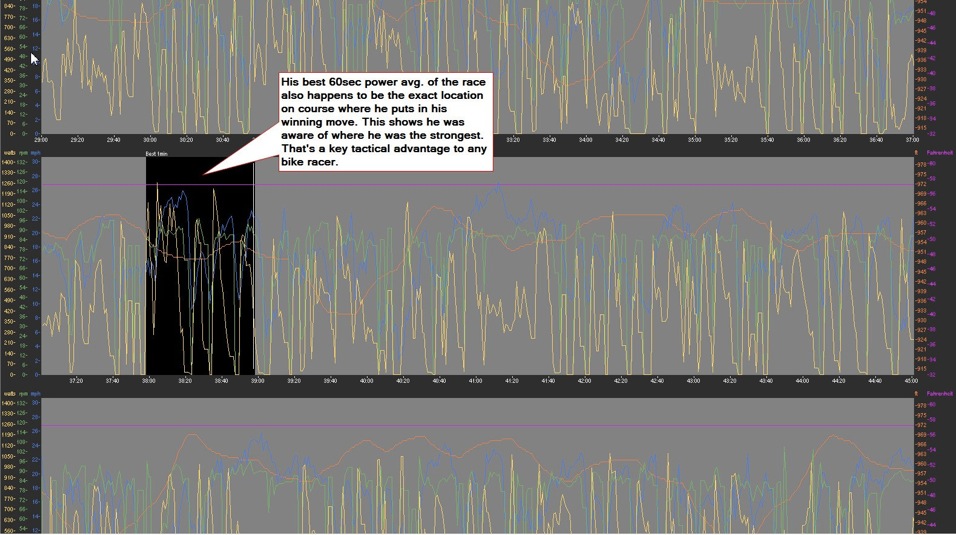
As I analyzed Ryan’s file, I looked closely at where Ryan attacked. I recall a short paved section after the long out-and-back grass field before the downhill to the run-up. It’s a perfectly suited spot on course to nuke it. During his attack, Ryan maintained about 800w (10w/kg) for just about 20 seconds. If you look at this same section during his first lap as compared to his last, he is almost 100 watts lower in power early in the race. This shows again his outstanding fitness, as he’s able to raise his output for the finale. Furthermore, this section where he lights it up is also the same area that shows his best one-minute power for the entire race. This tells me that Ryan was probably paying close attention to where he was the strongest. That’s a huge tactical advantage in any bike race. In bike racing, you want to race your strengths and manage your weaknesses. All part of his plan?
Trebon's best 1-minute power, also where he puts in his winning move. He was aware of the section he was strongest, a key tactical advantage! Photo and power file courtesy Ryan Trebon.
A Lot of “Wow” Numbers Here, Eh?
I don’t recommend comparing yourself to Ryan Trebon – you’ll find it’s quite humbling! I was in this same race with Ryan. My FTP is about 340w or 4.8w/kg, which, by Elite racer standards, is quite good! A good Cat 3 may be in the neighborhood of 3.8-4.0 w/kg. The gap between my FTP and Ryan’s is significant and certainly a game changer. Yes, I have power repeatability like Ryan, but my “ceiling” is lower and overall output range less. His lap times at Sun Prairie were on average 45 seconds faster than mine, leaving me three-quarters of a lap behind at the finish. That stat shows his absolute speed versus mine, and I’m not even factoring in his superior technical ability – something that we can’t yet track like we do wattage. [Note: we will attempt to quantify this missing element in a future article!] If we look at the longest sustained portion of the course (which is just less than a minute) and factor that Ryan can produce 7.2w/kg as opposed to my 5.9w/kg, you can quickly do the math and understand how he pulls away. Ryan’s greatest skills are his ability to create very high power through incredible force output, and the ability to repeat that power over and over.
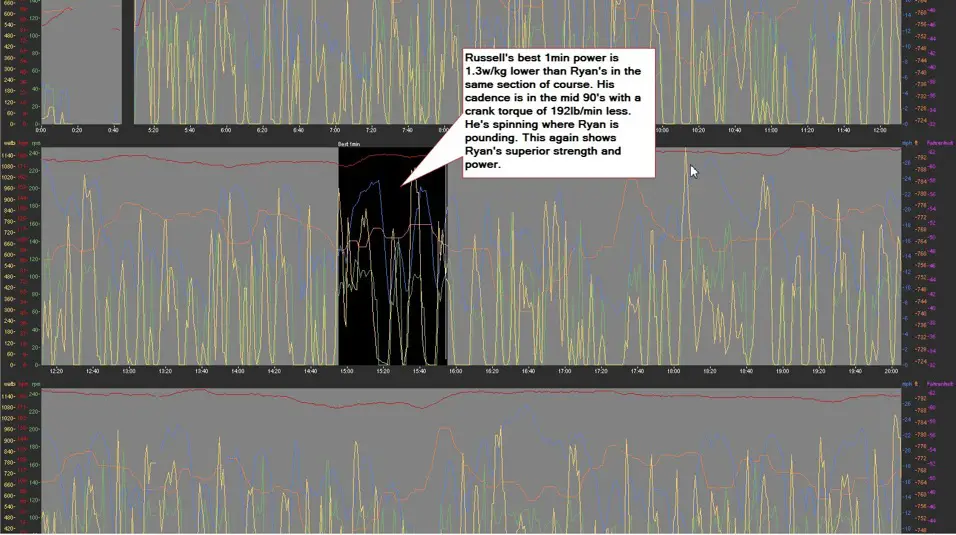
Russell's best 1-minute power, on the same section of course, is 1.3w/kg lower than Ryan's. Cadence is in the mid-90s, with a torque of 192lb/min less. Russell's spin vs. Ryan's power. Photo and power file courtesy Ryan Trebon.
Now we know what kind of output is needed to win a UCI C1 race. Let’s all go out and practice 1400w sprints, right? Well … maybe not. To compare yourself to Ryan Trebon is tough. He possesses some amazing physiological attributes comparable to the best in the world. The rest of us can, however, learn from these amazing feats to be stronger, smarter and more course savvy. Here are some tips …
  1. Build your Anaerobic motor. “Anaerobic” means efforts without oxygen, and by definition they are very short in duration, such as 30 seconds to two minutes. I hate to sound cliché, but “coffee shop” or mellow-paced ’cross bike rides won’t help you win races. You need to take yourself into the pain cave, repeatedly, for short durations in order to gain the explosiveness required for cyclocross. You’ll need to work on your repeatability, so start out with a longer rest/work ratio, say double rest to work, then gradually move towards a 1:1 rest/work ratio as you progress.
  2. Work on low cadence, high tension strength building, through “Big gear intervals.” Some folks swear by weight lifting to build strength, and it does work. I tend to lean more towards doing the heavy lifting on the bike. A lot of people think riding around at 50 rpm all day will give you more power, but that’s false. To create more muscular strength, you need to slow down to 8mph, put it in the 53/13 (or an appropriately tough gear for your ability), tighten the abs, hands in the drops, stay seated, then drill it until you reach 90 rpm. Once at 90 rpm, you aren’t creating enough strain on the muscles to cause them to adapt and improve. You can train you legs to have both explosive snap and long pulling power.
  3. Know your Functional Threshold Power. Establish your FTP to create a foundation point for your training.. Think of your FTP as the starting place for all the hard work you’ll need to do. If you are without a power meter, knowing your FTHR (Functional Threshold Heart Rate) or RPE levels (Rate of Perceived Excursion) is a good place to start. Establish where you are by doing a 20 minute time trial, taking the average wattage and subtracting five percent to determine your FTP. Then make a plan to build on it.
  4. Create a race plan! I never encourage racing blind or “just going for it.” Experienced racers know the courses and their competition, and they have at least a basic plan going into an event. I break my races down into “chapters,” making it easier to overcome small setbacks within the race. Knowing “I’m almost done with the chapter” helps me to focus on the short term, getting on to whatever is next.
  5. Practice, Practice, Practice. I came from a road racing background and had to learn cyclocross bike skills the hard way. (Translation: Many crashes!) I highly recommend taking some skills clinics or simply training regularly on your cyclocross bike with riders who are better than you. ’Cross racing is the whole package, not just how hard you can pedal.

Cyclocross Workouts  Find Your Inner Tree Farm!

Here are a few proven workouts I use with my athletes:
The FTP sprint – A True VO2 Max and Anaerobic Beast
1.5-2 hours total ride time spent mostly in Z2(65-75% of FTP) or Z3(76-90% of FTP). Warm up easy for 15-20 min, then do four 10 min intervals at Threshold (100% FTP, RPE 5 or 100% FTHR). Spend the first half of the interval at 100% FTP. In the second half, begin a series of 5-6 maximal sprints lasting 15-30 sec with nearly the same recovery times.
Looks like this: :15 max, :30 recover, :20 max, :30 recover, :30 max, :20 recover, :30 max, :10 recover, :15 max. Finished. Spin down at recovery pace for 10 minutes and repeat this three to four times. As you gain fitness, you can add additional sprints, push the interval duration out to 10 minutes and reduce the recovery time.

The Over-Under Sustain 
 Builds your VO2 Max Output

1.5-2.5 hour total ride time spent mostly in Z2 (65-75% of FTP) or Z3(76-90% of FTP). Warm up easy for 15-20min then begin three to four 10 min intervals using a long hill or false flat uphill road. Come to Threshold (100% FTP, RPE 5 or 100% FTHR) and hold for 3 min.
Push over your threshold to Z5 for 1 min (115-120% of FTP, RPE 7+ or 105% FTHR). Decrease to Z3 for 2 min (85-90% FTP, RPE 4 or 90% FTHR) then back up and over your Threshold again.
The complete drill looks like this: Threshold for 3 min, Z5 for 1 min, Z3 for 2 min, Z5 for 2 min, Z3 for 3 min, Z5 for 1 min and finished. Recover at an easy pace for 10 min and repeat the Interval three to four times, depending. Interval duration is approximately 12 minutes each for a total of 36 minutes of interval time spread over three to four sets. As you become stronger, reduce your recovery time between sets.
These are just two of many effective cyclocross or road bike workouts you can do to improve your high-end sustainability and maximal sprint. I’ll go into more training detail another time.
Russell Stevenson at 2011 Starcrossed. Photo courtesy.
Russell Stevenson at 2011 StarCrossed. Photo courtesy.
Hope you enjoyed the read! It’s my first forCyclocross Magazine, but not my last. I hope to follow up this story with something similar for women. The numbers may be different, but the wining formula is similar. So do you all know your W/KG by now? Are you wondering why Sue Butler or Katie Compton is lapping your ass? Remember, though, it’s not all about these numbers. There are many more factors, some hard to measure, that make the best ’crossers fast. More on this subject soon…
Peace!
Russell Stevenson is a USAC level 2 coach working for Peaks Coaching Group. He’s a certified bike fitter, Licensed Personal Trainer and Pro bike racer. He’s the 2011 Masters 35-39 road race champion and runner-up at last year’s Masters 35-39 Cyclocross Championships, both in Bend, Oregon. Russell is from Seattle, Washington, but now resides in Boulder, Colorado. You can find him on www.PeaksCoachingGroup.comor email him at russ@peakscoachinggroup,com. Thanks to Hunter Allen, head power guru at Peaks Coaching Group, for his help with this article as well.

Thursday, August 21, 2014

Variations on a Theme: Threshold Work for Cyclocross

Peaks Coaching Group Iain Banks Cyclocross Workouts Christian Sheridan

It’s the time of year when thoughts turn to cowbells, barriers, and mud. Yes, it is time for cyclocross. Rider approaches to cross vary widely; for some, cross is the focus of the season and they’re just ramping up their training, while others are winding down the road season and thinking about extending the racing with some cross. In both cases, there is a need to rebuild FTP (functional threshold power), but in a cross-focused way.

If you've been racing all summer, your power at threshold has declined as you focus on racing and recovering. Even if you haven’t spent the summer racing on the road and instead put in some long base rides to build aerobic fitness and endurance, you'll want to get a good block just topping off the tank, as it were. Nearly all riders know that riding in their sweet spot (88-93% of FTP) is one of the most time-efficient ways to increase FTP, but for cross there are some minor adjustments that can be made to make the workouts even more specific.

When it comes to specificity, let’s think about what makes a cross race different from other races. First, think about the start. The first half to full lap of a cross race is perhaps the hardest few minutes you can experience on a bike as everyone fights for position into the first technical sections. So the first recommendation I make is that EVERY workout begin with a five-minute blowout effort at VO2max intensity (zone 5 power).

The next thing about cross is that the effort is never steady; instead, there are lots and lots of jumps at near max intensity. In this way cross is like a technical crit, but with a key difference: in cross there is no pack and very little drafting. Yes, there are moments when you aren’t pedaling, but it’s not because you’re being swept along by the pack but because you’re setting up for a corner or obstacle. Besides those moments, you need to be on the gas, so we design workouts that mimic that kind of effort.

There are two ways I address this with my athletes: intervals with jumps and intervals with bursts. Essentially you perform tempo or sweet spot interval (e.g. 45-60 at 80-85% FTP or 2 x 20 at 88-93%) and at set intervals you perform either a jump (a 10- to 12-second sprint) or a burst (30 seconds at 110%+ FTP). The jumps help with accelerating after a slow corner or a remount, the bursts with those times in a race when you want to respond to or initiate an attack. But the key is that after the intense effort you don't let power fall below the zone for the interval. This forces your body to make a hard effort without easing off to recover, just like the uneven efforts you find in cross races.

Below are two of my favorite variations on classic workouts aimed at cross. I usually start with the tempo-with-jumps workout and begin with 30-45 minutes (depending on the length of the race) and work up to an hour.

Cyclocross Workout 1: Tempo with Jumps

WU: 10-15 minutes working into zone 2, with 3 x 1-minute fast pedal/low power efforts with 1 minute recovery between.

MS1: 5-minute blowout VO2max effort. Do 5 minutes at 110% FTP or Zone 5. Think of this as the first few minutes of a cross race; even if you’re not going for the hole shot, you need to maintain or improve your position. Recover 3-5 minutes afterwards (as you get stronger, decrease the recovery interval).

MS2: Ride 60 minutes in Zone 3. Within this effort do 12-20 all-out jumps of 10-12 seconds. Recover immediately to Zone 3 after each jump. Start with 12 jumps (every 5 minutes) and add more each time you do the workout.

CD: 10-15 minutes in Zone 1.

Cyclocross Workout 2: Sweet Spot with Bursts

WU: 10-15 minutes working into zone 2, with 3 x 1-minute fast pedal/low power efforts with 1 minute recovery between.

MS1: 5-minute blowout VO2max effort. Do 5 minutes at 110% FTP or Zone 5. Think of this as the first few minutes of a cross race; even if you’re not going for the hole shot, you need to maintain or improve your position. Recover 3-5 minutes afterward (as you get stronger, decrease the recovery interval).

MS2: 2 x 20 minutes sweet spot, with watts 88-93% FTP. Within this effort, do 5 x 30-second efforts at 110% FTP. After these 30 second efforts, return immediately to sweet spot, never letting watts fall below 88% FTP.  So, you are doing the bursts WITHIN the 20 Minutes. Recover 5 minutes between efforts.


CD: 10-15 minutes in Zone 1.


Photo: PCG elite coach Iain Banks powers over a cyclocross course. Original photo credit: Alex Pline.


Christian Sheridan is a Level 2 USAC cycling coach, an assistant professor at Bridgewater College, and a father of one living near Charlottesville, Virginia. He has coached athletes at all levels and has helped several athletes upgrade from Cat 5 to Cat 2. Christian can be contacted through info@peakscoachinggroup.com or www.peakscoachinggroup.com.

Thursday, October 1, 2015

Two Killer Cyclocross Workouts

Two Killer Cyclocross Workouts - Peaks Coaching Group

Cyclocross hurts, and so do the workouts that matter! Head out to your local CX course (or create one at a school or park) and give these two workouts a try.

Workout One: The 30-30-30

Warm-up

Ride 15 minutes in your endurance zone with a solid five-minute tempo effort to open up your legs.

Main set

Complete the following:
  • 1 x 5-minute blow-out with watts at 115% of FTP
  • 2 x 10-minute sets of 30-30-30: 30 seconds riding as hard as you can, 30 seconds coasting and not pedaling, 30 seconds dismounted and running fast. Repeat.
  • 5 minutes easy
  • 4 x 2 minutes AC work at 130% of FTP. Push hard and fast. Rest 2 minutes after each.
  • 10 minutes easy
  • Finish with 10 x 1 minute fast pedaling: 1 minute on, 1 minute off (cadence goal: 110 rpm).

Cool-down

15 minutes easy riding

Workout Two: Race Prep

Warm-up

Warm up for 10 minutes at 56-76% of FTP.

Main set

Complete the following:
  • 20 minutes of tempo (85-90% of FTP) with 5 bursts (10 seconds each) to 200% of FTP and return to 85-90% of FTP. Ride at endurance for 5 minutes at 70%. 
  • Now do 4 x 2 minutes, with 2 minutes between each. Try for 135% of FTP watts on each one. Do 2 additional efforts if your fourth one is still at least 120% of FTP.
  • Now ride at sweet-spot (88-93%) of FTP for 30 minutes, smooth and steady, and do 10 bursts within this 30 minutes: 200% of FTP for 15 seconds before coming back to 88-93% of FTP.
  • Finish with 2 hard efforts, each 5 minutes long with watts at 110% of FTP. Rest for 5 minutes between each.

Cool-down

10 minutes easy riding


Be sure to get in a good recovery shake afterward!


Want more awesome workouts? Contact us to try our custom training plans personalized specifically for you!


Hunter Allen is a USA Cycling Level 1 coach and former professional cyclist. He is the coauthor of Training and Racing with a Power Meter and Cutting-Edge Cycling, co-developer of TrainingPeaks’ WKO software, and CEO and founder of Peaks Coaching Group. He and his coaches create custom training plans for all levels of athletes. Hunter can be contacted directly via info@peakscoachinggroup.com or through PeaksCoachingGroup.com.

Image credit: Rena Schild / Shutterstock.com

Thursday, August 14, 2014

Bills, Bacon, and Beer: Mastering the Extracurricular Skills of Cyclocross

By Gordon Paulson, PCG elite coach
Image Credit: nwwineanthem.com
Cyclocross racing is different. Apart from the mount/dismount, suitcase carries, step-through dismounts, and bunny hopping, a CX race can present rare and mysterious challenges unlike those of a typical criterium. You’ll need to be prepared. Before you line up for your first CX race, make sure you’re ready for that ‘cross-distinguishing element: the hand-up.

Now if you want to get technical, there are most likely rules against accepting hand-ups in your ‘cross races, and there’s no feed zone. But it’s ‘cross; what’s a few rules to get in the way of general craziness? Hand-ups are as much a part of the culture as the dismount.

There are basically three types of hand-ups you should prepare for: bills, bacon, and beer.

Thursday, July 28, 2016

10 Tips for Junior Racers

10 Tips for Junior Racers

By PCG Elite Coach Mark Orton


Racing as a junior can be very rewarding, but it can also be very stressful. Here are some quick tips that will help aspiring junior racers keep enjoying the sport, and keep from burning out. 

   Take school stress into account. Don't plan any big race events within a week on either side of finals, midterms, prom, homecoming, or anything else that may stress you out. Don't have a tough training week on any of those weeks either. If you can work it into your schedule, make those weeks your rest and recovery weeks. 

   Try all kinds of disciplines. Give cyclocross, track, trials, bmx, mountain bike, road, or gravel a try. Different disciplines allow different strengths to shine. I’ve seen racers struggle to be an XC racer, then transition to Enduro and Downhill and excel! You’ll never know if you missed your calling if you haven't tried them all.

   Have fun and don't take things too seriously. If you get too serious, and specialize in one thing too early, you will burn out. We ride bikes because it's fun, don't forget that! Even if you’re on a serious training plan with a dedicated coach, be sure to work social and fun rides into your plan. 

   Play other sports and do other activities at least up until mid-way through high school, if not through college. A well rounded athlete is more attractive to college programs, and has developed a better sense of themselves, resulting in higher overall confidence levels.

   Do well in school, take school seriously. Your biggest supporters are your parents, keep them happy and willing to support your sporting endeavors by keeping your grades up. Most of us won’t make a living on the bike, so keep your options open by keeping your grades up. Plus, cycling is expensive, so when you move out you’ll need a good job to pay for this sport!

   Work with a coach that has experience with juniors and knows the differences between training juniors and training adults. Junior racers are not just small adults. When interviewing prospective coaches, ask questions about their training plans, ensure that they know the differences between coaching masters athletes and junior athletes. 

   Junior females, learn about the female athlete triad. If you are a female racer, you need to know about this. A great place to start is femaleathletetriad.org. If you are working with a coach, this is something you need to make sure they are aware of as well.

   Enjoy your success, and always strive to get better. Don't assume your success as a junior racer will automatically lead to success as you grow and progress. Differences in development create situations where there are imbalanced race fields. Junior racers each mature at different rates, so someone who may be underdeveloped this season, could have a growth spurt and be the most developed in the field next season.

   Work skills and the fundamentals more than you think you need to. Skills can keep you and other racers safe. Skills can keep you out of trouble. Skills will help you win. No matter the discipline you race, having well rounded skills can pay dividends and get you out of a tricky situation. It can mean the difference between touching wheels and riding away, and touching wheels and causing a pile up in the peleton.

   HAVE FUN!!! I can't say that enough, HAVE FUN!!!


Racing bikes is fun and rewarding. It will keep you in great shape, it teaches you lessons that you can apply to your everyday life, and it helps you develop into a responsible adult. However, if taken too seriously, too early, it can be a recipe for burn out. Using these tips will help you get the most out of your time on the bike, and add enjoyment to your training and racing.  

Wednesday, January 2, 2019

Video: APJunior Development Cycling Team - a start line for youth bike racing


From All Things Bike:

https://www.facebook.com/allthingsbike/videos/321069338708841

We kicked off our fourth season with a great talk with Bill Shattuck, Bart Lipinski, Lizzy Gunsalus and Mark Gunsalus of the AP Junior Development Cycling Team, a Massachusetts program that over the years has introduced boys and girls to cyclocross, mountain and road racing and helped them reach and exceed their potential as cyclists and people. 

Bill, Bart and Mark are cornerstone figures of the New England cycling community and Lizzy is the Future of New England Cycling and evidence of the program's success. Bill describes the history, routines and long term goals; 

Bart describes the riders, the parents and the rewards; Lizzy describes the training, the racing and how cycling has helped her mature; and Mark describes the mentoring, the support and the team camaraderie. A great insight into a long established and newly re-vitalized program (renamed in memory of New England Cycling friend and benefactor, Alec Petro) that helps youth get outdoors, compete, make friends and have fun. William Shattuck Bart Lipinski Mark E Gunsalus AP Junior Development Cycling Team PBM Coaching Peaks Coaching Group New England Bicycle Racing Association New England High School Cycling AssociationFit Werx A-D Bikes Frame and Wheel #usacycling #lizzygunsalus